Sunday, March 8, 2026

2026 BTT picks

 Tuesday winners: Oregon and NW

Wed winners: Oregon, Washington, Indiana, Minnesota

Thur Winners: OSU, Wisc, Purdue, Minnesota

Fri Winners: Mich, Illinois, Purdue, MSU

Sat winners: Mich, Purdue

Sun Winner: Mich

Sunday, March 30, 2025

Reflecting on 10 years of Greg Gard

Torvik and I were talking at the first round NCAA games this spring, and the topic came up about Gard's results, especially as it related to what we thought the possible outcomes could be on Dec 15th, 2015. At that time, Bo Ryan had just retired and while coming off back to back Final Fours, the team was reeling at 7-5 with embarrassing early season losses to UW-Milwaukee and Western Illinois at the Kohl Center. At that moment, it seemed like this could be the end of an era. Gard was known to Wisconsin Badger basketball fans, but was hardly a hot coaching candidate here or anywhere else. 

A return to the pre 1994 era of desolation seemed very possible, although the improvements of the last couple decades to the basketball program and Badger brand in general made it not likely. An improvement over the Ryan era while theoretically possible, seemed like a 1% chance or less. Falling somewhere in between where NCAA tournaments are no longer guaranteed, championships rare, and really bad seasons are again possible seemed most likely. Torvik and I came to the conclusion that from that moment in Dec 2015, what has occurred is a top 10% result of what we imagined was possible. 

Gard is 177-95 overall and 98-61 in Big Ten play over his 10 years (well 9 and 2/3). He has won 2 Big Ten regular season Championships, has 7 NCAA tournaments (would be 8 with COVID season), and 2 sweet 16s. 

Where does he rank among coaches in the history of Badger basketball? Third. The answer is third. 

Doc Meanwell and Bo Ryan are #1 and #2 in some order. It is difficult to compare eras, and which is which is a topic for another blog post. Gard is third. Dick Bennett and Bud Foster have an argument here for third largely based on their miraculous post season runs which Gard has yet to duplicate. Foster won the 1941 NCAA championship, but had a losing record at 265-267 overall and 143-182 in the Big Ten over his 25 seasons. Dick Bennett had just a 6 year run in Madison which culminated in that amazing run to the Final Four. He was 93-69 overall, and 39-45 in Big Ten play. We'll never know what might have happened if Dick had not burnt out and retired. He may have led many more Badger teams to greatness, but all we'll ever know is that it led to Bo Ryan, and greatness nevertheless. 

As the Badgers yet again exited the tournament before the Sweet 16 this year, the narrative around Gard persists. His only 2 Sweet 16s came in his first 2 seasons, with players from the Bo Ryan era. Some will call his 10 years a failure because he has failed to return to the second weekend of the tournament. I am not one of them. All seasons end with a bitter taste in the mouth except for one team. 

Gard is just 54 years old, and with deep ties to the state it seems likely he could stay at UW for another 10 years or more. I think Paul Chryst thought the same thing at one point, so obviously anything can happen. A couple bad seasons and any coach is gone. The NIL and transfer era is filled with uncertainty, and all the strong fundamentals the Badger brand has been built on could all be destroyed by the new system. That said, I'm more optimistic about the future for Badger basketball now than I was on Dec 15th 2015. The possibility of a return to 1948-1993 desolation seems less than 1%, the greatness of Conference Championships and deep tournament runs don't seem like a pipe dream. If the next 10 years include 2 Big Ten Championships, 2 Sweet 16s, and 177 wins, it will again be a great outcome. 

I hope Gard makes a deep tournament run some day, because selfishly those runs are so much fun. There are so many great coaches that never get there though. I watched Gene Keady win tons of games and never get there, but the joy he brought to Purdue fans with all that winning is worth so much more. Perhaps I'm soft now that I'm old, but the joy of the journey is so much more valuable than the outcome of the final game. When your team is in the hunt, every game matters. When every game matters every game is fun. When your team is in the hunt, the dreams of what could be in between games brings fans and friends together. That journey almost always ends in pain, but that journey is amazing and I hope Gard gives me many more over the next decade. 


Monday, March 11, 2024

2024 Big Ten Tournament Picks

 Adam

Wed winners- Maryland and PSU

Thur winners- MSU, UW, OSU, PSU

Fri winners- Purdue, UW, ILL, Neb

Sat winners- Purdue, ILL

Champion- ILL

Tuesday, March 7, 2023

Big Ten Tourney Picks

 Here they are Torvik:


Wed- Neb over Minn, UW over OSU

Thur- Mich over Rutgers, Iowa over UW, Illinois over PSU, Neb over Maryland

Fri- Purdue over Mich, Iowa over MSU, Illinois over NW, Indiana over Neb

Sat- Purdue over Iowa, Indiana over Illinois

Sun- Purdue over Indiana

Monday, November 28, 2022

Fickell and Chryst

I don’t remember the last time I blogged about football, but with the Fickell hire it seemed like a good idea to post some thoughts. If for no other reason than so that Torvik can throw it back in my face in 10 years when I’m wrong. 

First, I didn’t like how Chryst went out. I don’t know (and I don’t think anyone else does either) what went down between Chryst and McIntosh, but it doesn’t sit well. He averaged 9 wins a year and should have had a chance to turn the season around. Good guy, good coach, got a raw deal at the end. It’s entirely possible the criticism of Chryst is valid, and the program was going downhill. The recruiting department took some hits, the offense was bad again, Chryst seemed to struggle with diving into NIL and the dirty business this will entail for college programs here on out. Still, he had a formula that worked at UW and I think he would have continued rolling out 9 wins a year for the next decade given the chance. We’ll never know what that universe would have looked like, nor the one where Jimmy Leonard took over the program, nor the one where Chryst was fired last year and replaced with Leonard like many wanted. So what are we looking at. I’ll draw up 3 possibilities and what I think of each.

 1) Fickell takes WI to the next level and makes them a perineal power, B1G title and National Championship contender. This seems like the most unlikely scenario, but also the expectation that McIntosh and the majority of the fan base are putting on him. He caught lightning in a bottle with mostly 3 star guys at Cincy and went to the playoff, so why not here? Just rinse and repeat in Cardinal and White, right? So with this we are basically banking on the fact Fickell is another Barry or Bo. A genius who can take middling players (athletically) and turn them into champions through training, scheme, etc. I guess it’s possible, but I’m not hopeful. Chance of this scenario- less than 5%.

2)  Fickell takes WI straight into the tank. This is the horror scenario, and I think we narrowly avoided this already when Gary Anderson left us (thank God). If you think this can’t happen just look at what happened to MI between Carr and Harbaugh, or look at Nebraska today (one of the most storied programs in college football with rabid fans, great facilities, and solid recruiting). That could be us. Fickell could be our RichRod changing the scheme, changing the recruiting, and losing an already fickle and quick to bail fan base. If it goes this way it may never come back. Barry was a great but also lucky hire. Other than Fickell, no other hot coach in demand has wanted this job despite 2 recent openings when Anderson and Chryst were hired. If the program tanks, it will take another Barry to resurrect it, and those guys are hard to come by. Chance of this scenario less than 20%. 

3)  Fickell spends the next 6-9 years at UW and wins about 9 games a year. He has a couple years where we overperform and make it into an expanded playoff with 11-12 wins, and a few years we underperform and barely make a bowl game. Sound familiar? It should because this is what we are. We won’t get to the next level because of recruiting. Fickell said in his press conference we will recruit “within the 300 mile radius”. That’s because almost all kids stay within that range of home when picking a school. We just don’t have enough 4 and 5 star kids within 300 miles to compete with schools in Ohio, Florida, Texas, etc. that have 10 times what we have right next to home. We will bring in 3 star kids, we will develop them, we will get some special kids here and there that take us to double digit wins. That won’t sustain a championship level program though year in and year out, you just need more 4 and 5 star kids that live nearby, and we just don’t have that. Chance of this scenario- greater than 75%.  

Sunday, October 30, 2022

Random thoughts on the Eau Claire exhibition game

In no special order, here are some things I thought about during the Badgers Exhibition game against Eau Claire today.

No huge red flags. Barring injuries this team should be fine. There were not constant defensive lapses like in Davison's first year where the team was clearly lost. Outside of Essegian, the shooting was bad. Probably not bad enough to tank the season, but bad enough to hold them back. 

Essegian's first three point shot attempt was a nervous miss, but his last attempt was a thing of beauty. Clearly he had some nerves being on the floor at first, but was working hard and hustling. There was not a ton of confidence in the first shot. On his last 3 point attempt he caught, set, and shot in one super quick motion that showed why he will be in the rotation this year. 

It was super quiet when the badgers were on defense. After 5 years of Davison constantly yelling out screens and defensive calls very loudly, the silence on the defensive side of the court was very noticeable. There were still screen calls and the defense didn't seem to have any major problems with communication, it was just very different after so many years of hearing Davison call out everything. 

Backup point guard- McGee got first crack at it, and if needed he could give Chucky a rest for 4 minutes a half. He got yanked early in the second half when he made a terrible full court pass into traffic that got intercepted. The other option they used was Klesmit at point with Wahl and Gilmore for support. Klesmit is not natural there so I'm not sure this was a better option, but Wahl has run point as a forward before and could do this again if McGee isn't doing enough to earn minutes. 

Wahl was the best player on the court. He was aggressive offensively both getting his own shot and getting others theirs including pushing the ball to get into transition (although not often, it is the badgers). I expect Wahl to lead this team in scoring. He has developed an almost Happ like touch around the basket, and if he can get anything on the perimeter he will be a a very tough cover. 

The Badgers continued switching most screens but went over on some too. Once they play a better opponent it will be interesting to see if this changes, but seems like mostly switching is the defense going forward. On a few occasions they did bring help down or toward the top of the key from the weak side of the floor perimeter defender. This gave help but left that player open from three. I don't remember the badgers doing this much before, and maybe it was just because that player did not need to be guarded from 3. It's a different way to help, but we'll see if they do it at all going forward. 

The starting 5 looked fine outside of Chucky's shooting woes. This could be the starting 5 all year or not, but I think it's safe to say these 5 will be part of the 7-8 guys getting significant minutes this year. The other 2-3 guys are not as clear. Below is what I saw from others trying to get into that group. 

Essegian seems likely to be in that group. His shooting is just too valuable on a team where that is a weakness. He'll get yanked a lot and have stretches where he struggles but we just don't have anyone else like him. 

I was a Carter Gilmore hater last year. Hopefully I will not be one at the end of this year, as he looks to be in that group of significant contributors. He was fine today but still is very hesitant to shoot on offense, and he needs to be willing to do that. With no other big man depth, he will probably be asked to do more than you want to put on him. 

Will there be an 8th guy or just a bunch of people rotating in? Neath seems like the most likely option to get a bunch of minutes of what is left. He was not good today and picked up a couple fouls being way too aggressive. He also jacked up a long mid range 2 off the dribble, that looked like a selfish "I haven't got any shots up today so I'm jacking this no matter what" type of play. Still, his size and defensive versatility give him the ability to guard 4 spots, so he is probably the 8th guy. 

Mcgee- See above about PG. I think his ceiling is he plays 4 minutes a half to get Chucky a rest, but it's also possible they let others play point and he only gets spot duty. 

Hodges- I had hoped (based on nothing) that he would be able to play since there is no frontcourt depth. I think he was the 11th guy off the bench in the first half, and was still on the court with the walkons to close out the game, so that is not promising. When he was in, he did some good things, but it seems likely he does not play much unless fouls/injuries require it. 

Ilver- He does have some smoothness to him but I can't help but think Van Vliet. Totally unfair to him, but it keeps popping in my head. He also did some nice things when on the floor, but was also out there with the walkons at the end of the game. 

Lindsey- Never know, but I doubt he gets of the bench except garbage time. 

Thursday, March 10, 2022

Big Ten Tourney picks

 Chorlton, it's that time again. Time for me to embarrass you by picking the rest of the Big Ten tournament.

Yes, we forgot about Wednesday. But Wednesday is the play-in day. Those games don't count.

Here we go - get your picks in or lose by default. I've spent no time thinking about this, so I'm about to intuit the future.

THURSDAY

Indiana over Michigan

MSU over Maryland

Iowa over Northwestern

Ohio St. over Penn St.

FRIDAY

Indiana over Illinois

MSU over Wisconsin

Purdue over Ohio St.

Iowa over Rutgers

SATURDAY

Iowa over Indiana

Purdue over MSU

SUNDAY

Purdue over Iowa


Wednesday, February 9, 2022

Carolina and the Quarrel with Quadrants

It's February, so bracketologizing and bubble watching are getting into high gear. (If you're keeping track, it's the fourth-most wonderful time of the year according to my seasonal analytics.)

One of the more interesting résumés at the moment is North Carolina's. For the most part, UNC looks like a team that is directly on the bubble: 


But there's a glaring goose egg sitting there: 0–7 in the almighty "Quadrant 1" games. Sure, they're 4–0 in the semi-mighty "Quadrant 2" games, but the punditry is unanimous: Carolina just can't dance without at least one Quad 1 win. 

I've got some quibbles with this Quad 1 absolutism.

First, it's really not unprecedented for a team with this type of résumé to make the tournament. It's true that no sQuad Zero has made the tourney since the invention of explicit quadrants in the 2017-18 season. But that's just three tournament selections, and for the record there were three teams invited with just one Quad 1 win in even this short period:


Nevada even got a 7-seed with just one Q1!

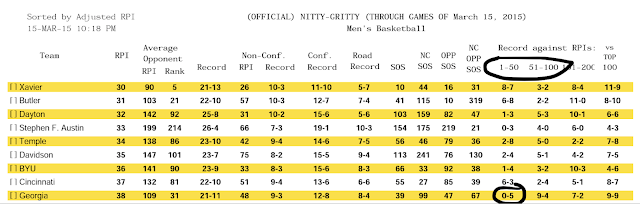
Yet just as three is greater than two, one is greater than zero. Perhaps infinitely so. This gets me to the real meat of my Quibble 1: the quadrants existed in spirit looooong before 2018. If you were alive back then, you will remember that the selection committee focused on something different but really the same: top 50 wins and top 100 wins. I can tell you with absolute certainty that the committee used top 50 RPI wins the same way they use Quadrant 1 wins now. The only difference was that our beloved quadrants flex for home and road, as they should. The quadrants were a big improvement, but were just a tweak of the familiar paradigm. For example, here's the 2015 Selection Sunday "Nitty Gritty" sheet showing the proto-quads (with a spoiler alert):


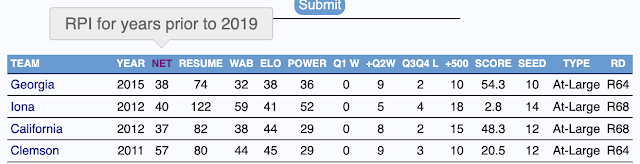
This means we can safely look back before 2018 to get actionable intelligence about the plausibility of a 0Q1 team making the tournament. What we find is that there is indeed precedent for teams making the tournament with zero top line wins:

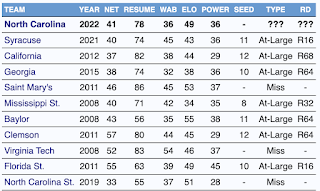
One other thing you might notice about each of these teams is that they all had multiple bad losses (outside the RPI top 100 in those days) and still got in. Anyhow, unsurprisingly, three of these four teams show up in the default list of ten most similar résumés for North Carolina 2022 on my site:


Georgia in 2015 is almost an exact match, particularly in the categories that matter most. There you have it. It's been done. It could happen again.

On to my second, more fundamental, quarrel with Quad 1 absolutism: Quadrants are kind of dumb! Which would be okay if we needed them, but we don't!

Long, long ago, in a time before the NET, I wrote on this very blog that:

Alas, the NCAA did not do this. First, they invented the home-road affected quadrants, and then they replaced RPI with NET. Both of these changes made the selection process better. I'm a fan of NET, relatively speaking. For judging the quality of a team's wins and losses, which is what they are basically using NET and the Quadrants to do it works pretty well. 

But what they really should do is use the NET to calculate an official NCAA version of WAB or Strength of Record. I think they shouldn't even publish the NET at all—just use it behind the scenes as the backbone for the simple calculations required to turn it into a strength of record ranking.

They should do this because there are more than four levels of opponents in NCAA Division 1 basketball. In fact, there's probably at least 100 levels. Pretending like there are only four different kinds of wins and losses might make sense if we didn't have good ways to rate teams and didn't have computers to do calculations for us. But thankfully we have those things, and lots of them. We can do this. We should do this. 

To bring this back to UNC, we know that the Tar Heels would be in much better shape under any system that more rationally quantified the impressiveness of their record. We can see that they're a lofty 26th in ESPN's Strength of Record, which is one attempt at the kind of system I'm arguing for. They're a solid 35th in my own superior T-Rank-based WAB rankings. They'd still face scrutiny because of their particularly heinous performances against the best teams they've faced, but at least they wouldn't have to face the (false, actually) argument that inviting them would be totally unprecedented.

Monday, February 8, 2021

2 foul auto-bench

The 2 foul auto-bench

I have frequently seen criticism of the 2 foul auto-bench strategy recently. I’m not a complete believer in the auto-bench in 100% of circumstances, but I certainly understand why a coach would do it. It feels to me like the argument against the 2 foul auto-bench has become like the argument for fouling when up 3 at the end of the game, in that people argue that it is clearly they best strategy when it’s not clear that it is. They also seem to ignore all the good reasons to bench the guy, and assume nothing bad will happen. They seem to think the player will get their normal minutes and be their normal productive selves with the 2 fouls, and even if they get a 3rd, they are still unlikely to foul out. If this were true, it would be a no brainer to leave the player in with 2 fouls, but here are some considerations as to why this is not always the case.

1)     If a player has 2 fouls, they can’t really play defense well, because they have to protect themselves. Most often the auto-bench criticism comes when a good offensive player is sat down because the team needs his scoring. This ignores the fact that the gains in offense by keeping him on the court are offset by worse defense because they can’t play the defensive scheme correctly in order to not risk the 3rd foul. This is compounded in the team defense because the other players on the court can’t count on the 2 foul player to do what the system dictates they should do, and can put every other defender on the court in bad positions.

2)      Auto-benching is a tool to teach the player and the team not to foul. Coaches don’t coach to win 4 minute segments, they coach to win games and championships. If you have a defensive system that is based on not fouling, you can’t tolerate players racking up 2 fouls each half. Fouling puts other team in the bonus and makes your other fouls hurt more. Many teams defensive scheme is based on minimizing fouls at the expense of ball pressure, creating turnovers, etc. If this is your philosophy, then you can’t tolerate players fouling 2 times in a half. A great coach once said, “Coaching is more about what you accept than what you say”.

3)      Sometimes a player committing fouls too frequently just isn’t playing all that well. If they’re not moving their feet in the first 10 minutes, why would a coach think that is going to change in the next 10. If a player is shooting poorly, is 0-5, and coach sits him to think for a bit, you don’t hear the same criticism as a coach benching with 2 fouls because a player is playing defense with his hands instead of his feet.

Here are some other short considerations that play heavy into the decision to bench the 2 foul player:

1)      Can you protect him? Can you stick him in the corner in a zone, or put him on a non-offensive threat in man to man?

2)      Does your team play pressure on the ball? If so, can you do so with this player on the court?

3)      Who are you coaching against? Are they a coach that will recognize the matchup and can use iso on the wing or on the block against them, or put the player in a pick and roll defense?

4)      Is it a player that commits a lot of fouls, or someone that is not a fouler?

5)      Are you playing a team that draws a lot of fouls?

6)      Are you up or down a significant number of points, and who is your opponent? Are they way better than you or way worse? Do you need the player on the floor to compete?

7)      Who are the refs, and are they calling tons of ticky tack fouls, or are the letting everyone play?

8)      Players that just got called for a foul are often frustrated. Frustrated players seem to be more likely to commit another foul. (just seems that way to me anyway)

I’m not an auto-bench lover myself, but I would like to hear some of these considerations talked about when the auto-bench comes up. Seems like the issue is over simplified. Too many assume that the low risk of a 3rd foul is the only possible problem when leaving them on the court, when in fact there are many other factors to consider.

Saturday, December 12, 2020

Early look at Home Court Advantage in Covid Season

With some frankly disturbing exceptions, most college basketball games this year are being played in empty or near-empty arenas. This raises an obvious question: how much does this affect home court advantage (HCA)?

It's a reasonable assumption that lack of fans will reduce home court advantage, and I lowered the HCA factor in my ratings from 1.3% to 1.0% coming into the year. But I am tracking it (or at least attempting to)to see whether it needs to be further adjusted. Here's what I'm looking at so far.

I calculate and apply HCA by looking at how many more net points home teams score than my ratings project they should. For example, if two perfectly evenly matched teams play, and the home team ends up winning by 3 points in a 50 possession game, that's an HCA of 6 points per 100 possessions. Here are the actual results of that method over the last three years, plus this year so far:

Year Games HCA/100
2018 4873 5.14
2019 4934 4.93
2020 4877 5.22
2021 438 5.53

Looking at this, you might conclude that HCA is as strong as ever so far this year. But that would be wrong. Things look quite a bit different if you look at just the first 17 days of each season:

Year Games HCA/100
2018 662 6.24
2019 555 6.33
2020 666 6.42
2021 438 5.53

On this view, HCA is about 13% reduced from the average of the last three years. Basically, HCA is usually higher at the beginning of the year, probably because it is generally higher in mismatches, and mismatches are common early in the year.

In fact, if we break this down and look at only games in the first 17 days involving teams who are ranked within 100 spots of each other, there is a huuuuge drop-off this year:

Year Games HCA/100
2018 293 5.59
2019 236 5.69
2020 300 5.89
2021 215 2.18

Here, in a fairly similar number of games as previous years, HCA is down by more than half! Given that the overall number is only down about 12%, that means that HCA in uneven matchups (where the difference in team ranks is more than 100) is actually UP quite a bit:

Year Games HCA/100
2018 369 6.75
2019 319 6.8
2020 366 6.86
2021 224 8.78

What is the difference in these games? Well, one possibility is officiating. In the evenly matched games, home free throw rate is just a 1.18% advantage for the home team (versus an average advantage of 3.4% in the previous years. Meanwhile, in mismatches the home team is mostly retaining its usual advantage in getting to the line: 3.2% versus 4.3% in those kinds of games in previous years.

Where does that leave us? It's too early to make any firm conclusions. Another couple caveats I want to add: (1) this analysis is kind of down of dirty because I'm not fully backing out the effect of HCA in the first place when considering team quality (which could especially be skewing the results this year of teams that have not played road games), and (2) the results for this year are obviously hard to disentangle from errors in the preseason projections.

But a couple things I'm confident in saying: HCA still exists, even with few fans in the arena, but it is attenuated to at least some degree. Maybe a lot in real games.

Now for some speculation. Perhaps the difference that shows up between more evenly matched games and mismatches reflects that Covid-related travel and other restrictions are particularly rough on low major teams. And perhaps the vast majority of HCA that remains is more related to this kind of travel fatigue, and has largely replaced implicit officiating bias as the main driver of HCA for now.

Update:

I did some more work on this to back out HCA for team quality. The raw numbers are different (slightly less HCA overall), and make this year even closer to a normal year so far, but the basic ratios / conclusions noted above still hold. In particular, the marked split between closely matched and mismatch games still holds, although the "through day 17" split is now close enough to be reasonably considered possibly just noise.

Monday, May 25, 2020

What to make of Rick Pitino to Iona?

After a couple years in Greece, Rick Pitino is coming back to coach college basketball next year at Iona College, a member of the MAAC. This is a pretty unusual situation, obviously. Pitino is already a Hall of Fame coach, with six* Final Fours and two* NCAA championships. And when he left Louisville prior to the 2018 season, he was still putting together great teams—it wasn't like the game had passed him by and he was put out to pasture. So it's intriguing to think about what such an established coaching legend might be able to accomplish in a one-bid league.

I asked the hive-mind on Twitter for some historical analogues, and here's what we came up with, listed in approximate order of similarity (in my opinion):

Larry Brown to SMU

This is probably the closest analogue in terms of coaching ability and situation. Brown made a Final Four at UCLA and won a title at Kansas before heading off for a successful couple of decades in the NBA (where he won a title with the Pistons).

SMU was a decidedly moribund program when Brown arrived, having missed the tournament for about 20 years in a row. They struggled through one more year of mediocrity under Brown before his methods, such as they were, resulted in Madness. Brown ended up lasting only four seasons, and he left under a cloud of impropriety, but he had tournament-quality squads his last three years.

Could Pitino build a (clean) Brown-at-SMU type program? I think that's optimistic. SMU was in a multi-bid league by Brown's second year, and had considerably more resources than Iona. But I think something just a step below that is achievable. The main lesson is that even in this relatively best case scenario (basketball-wise), there was a transition year before the superior coaching (etc.) turned into more wins.

Jerry Tarkanian to Fresno State

Tarkanian built an indisputable mid-major powerhouse at UNLV, where he went to three Final Fours and won a title. Like Larry Brown, he is legendary for his run-ins with the NCAA, which led to his departure from UNLV just a year after winning that title. After a brief stint in the NBA and a few years in the wilderness (litigating against the NCAA), he returned to coach his alma mater, Fresno State.

He was immediately successful, going 22-11 in his first year—the most wins for Fresno in over ten years. He continued to win 20+ games every year and built the program into an at-large quality team, eventually earning back-to-back 9-seeds in 2000 and 2001. The 2000 team lost, of course, to the Final Four bound Wisconsin Badgers. Unfortunately, these later teams were subsequently the subject of NCAA sanctions.

This is certainly a favorable comparison for Pitino (other than the sanctions stuff). Tark immediately built a contender in the WAC—and this is back when New Mexico, UNLV, and Utah were in the WAC, and the conference regularly sent 3 or 4 teams to the tournament. Like Iona, it was a program with some pedigree (Tiny Grant took them to the Elite Eight in 1982) but nothing like the powerhouse that Tarkanian was coming from. Ultimately, I'd say this is an example in favor of expecting bigger things out of Iona this year.

Rollie Massimino to Cleveland State

It seems fitting to follow Tarkanian with Massimino, who replaced him at UNLV. Massimino had a legendary 19-year run at Villanova, capped by a miraculous run to the 1985 title as an 8-seed.

The UNLV interlude is problematic for our purposes. First, he left Villanova for UNLV after four straight years with at least 15 losses (though he did go to the tourney in two of those years). So his career was already on a downward arc. Second, he had an undistinguished two-year tenure at UNLV that, according to Wikipedia, ended with him being "forced out when it was revealed that he and UNLV president Robert Maxson had cut a side deal to lift Massimino's salary above the figure being reported to the state of Nevada and the state commission ruled that this had violated both state ethics laws, as well as UNLV rules." 

So when he took the job at Cleveland State a few years later, it was less of a giant stooping down than a natural step in a parabolic career arc.

He did okay at Cleveland State. They were coming off a 5-win season, and Massimino won 9 games his first year. Then 12, then 14, then 15, then 19 ... But he never took them over the hump or got to the tournament. Inconclusive at best.

Bobby Knight to Texas Tech

Knight was proposed to me somewhat tongue-in-cheek, but the more I think about it the more analogous it seems.

Bobby Knight's bona fides as a coaching legend are beyond dispute and need no recounting. Sure, he was not at his apex when Indiana fired him for finally going too far with the "I'm a total psycho" stuff off the court, but he had still taken IU to fifteen fucking tournaments in a row.

The tongue-in-cheek part is really about Texas Tech, in that it was not and is not a mid-major in any real sense. But it was a team that had missed 13 out of those 15 NCAA tourney that Bobby Knight had just taken Indiana to. As far as major-conference programs go, that's bottom of the barrel. (And, by contrast, Iona has been to 6 of the last 8 NCAA tournaments under Tim Cluess, so ...)

Knight was immediately successful at Texas Tech, winning 23 games his first year and going to the NCAA tourney. The next three seasons were also successful (by Texas Tech standards of the time) culminating in a run to the Sweet 16 in his fourth year. Then things turned toward mediocrity, especially by Knight's standards.

Knight certainly turned Tech around in a hurry, showing how important the head coach is in college basketball. Although the program comparison between 2000-ish Texas Tech and current Iona is not really on point, it was certainly a big step down for Knight. So this is an encouraging example for Pitino.

Lefty Driesell to James Madison

I had to be talked into this one, because although Driesell did eventually make it to the college basketball Hall of Fame, I don't think he had that status when he left Maryland. It was really what he did afterwards, at James Madison and Georgia State, that cemented his legacy as "the greatest program builder in the history of college basketball."

This is not to imply that he was unsuccessful at Maryland, where he coached from 1969 to 1986 and went to three Sweet 16s and two Elite Eights. But he never got to the Final Four (much less won a title), which certainly puts him on a different level from Rick Pitino and the coaches already mentioned.

That said, his coaching tenure at Maryland did end "unnaturally" in that he was forced out for non-basketball reasons. And he certainly had some success at James Madison and then Georgia State. At JMU he went through the typical transition year and then won at least a share of the CAA regular season title for the next five seasons. After a few down years at JMU, he had immediate success at Georgia State, culminating in a heartbreaking (to me) victory over Mark Vershaw and the Badgers in the first round of the 2001 tourney.

Driesell was not as old as Pitino, and not as great a coach, but his mid-major success is an example for Pitino to follow.

Bobby Cremins to College of Charleston

Bobby Cremins is no Rick Pitino, but he had a long and distinguished run at Georgia Tech, including a trip to the Final Four in 1990. He retired in 2000, but was lured out of retirement by Charleston for the 2007 season.

Iona and Charleston are pretty good analogues in that they were both consistent contenders in their conferences before landing their late-career coaching legend. Tim Herrion, Cremins's immediate successor, averaged over 20 wins in his four seasons but never went to the tourney. But Herrion's predecessor, John Kresse, had fantastic success and dominated the TAAC/Southern in the 90s.

Cremins kept alive this record of decent mid-major success, but never really broke through or returned Charleston to the tournament.

Honorable Mentions with brief summary:

Jim Harrick to Rhode Island

Won a title at UCLA, and had instant success at Rhode Island. Dogged by scandal everywhere, though. Overall, Harrick not on Pitino's level, and Rhode Island clearly above Iona on the pecking order.

Steve Fischer to San Diego State

Steve Fischer was only 52 when he was fired by Michigan as part of the Ed Martin scandal. So even though he had tremendous success at Michigan (including an out-of-nowhere run to the 1989 NCAA title when he replaced Bill Frieder right before the tournament, and two Final Four runs with the Fab Five), his status as a coaching great was not really established until he built San Diego State into a west coast powerhouse.

Also, San Diego State is a clear step or two above above Iona on its own terms and in terms of conference affiliation.

Tubby Smith to High Point

Another coach with an NCAA title on his resumé, but by the time Tubby went to High Point, the shine on his star was long gone.

Mike Dunleavy to Tulane

Dunleavy never had any success in college, but he did have a long and sort of decent career in the NBA. So you might have thought he would do well at Tulane. He did not.

Jim Calhoun to St. Joseph (D-III)

Calhoun certainly is on Pitino's level as a coaching legend. But it's hard to really compare starting up a D-III program to taking over at Iona. For what it's worth, Calhoun is off to a good start.

Monday, March 9, 2020

A Coach of the Year Polemic

What is the Coach of the Year award for?

If you answer this question by looking at results, the answer is pretty clear: the Coach of the Year award typically goes to the coach of the team that most exceeded expectations. Another way of putting it:


I'm here to say that's the way it should be.

Just like the preseason AP poll tends to give a fairly pure view of how good knowledgeable people think a team will be—before dirty game results sully the analysis with overreactions and the like—preseason expectations for a team give us a pretty pure view of how talented people think the roster is.

There are many reason a team could outperform its presumed talent. Obviously the presumptions of talent could be quite wrong. That happens all that time. It could be just luck. That no doubt happens all the time. But generally speaking when a team outperforms its presumed talent level, I think it's fair to attribute at least some of that variance to coaching—superior training, development, and game strategy.

That's a sound theoretical justification for giving the Coach of the Year award to the coach of the team that most outperforms its preseason expectations. It's not at all dumb. Let's just accept it.

There are two main objections to this regime:

1) Why shouldn't preseason favorites be eligible for coach of the year?

and, relatedly,

2) Recruiting is coaching, too, and this doesn't account for that.

Both of these objections are wrong.

First, under this regime, coaches of preseason favorites are eligible to win Coach of the Year, and they do. Even favorites can wow us with their overachievement. For example, John Calipari was national Coach of the Year in 2015 despite having probably the most talented roster in the one-and-done era. Bo Ryan won B1G COY in 2015 leading a preseason top-5 juggernaut. There are many examples.

Second, and I cannot emphasize this enough, recruiting is not coaching. Coaching has a general meaning that applies to all sports: training players, developing players, and directing game strategy. Recruiting, program-building, fundraising, glad-handing, press conferences, etc.—these are all things college basketball coaches have to do, but none of those things are coaching. The Coach of the Year award need not (and should not) consider them.

Most sports have a Coach of the Year award. In professional sports, coaches don't get credit for having great players (even if they happen to also be the GM that drafted them) because it's understood that coaching and roster construction are different things, and the Coach of the Year award is for the coaching part. Just because the person called "Coach" happens to both coach and recruit doesn't mean recruiting is coaching. It isn't. It just isn't.

The existing regime for deciding Coach of the Year focuses, appropriately, on coaching: instruction, development, game strategy. That's reasonable and appropriate. There's no need to muddy the waters trying to evaluate the non-coaching duties.

Saturday, November 2, 2019

First impression- Badgers are 5 deep

Always a bad idea to jump to conclusions after one exhibition game, so here it is. 

The starting 5 looked solid. Ford and King looked healthy and more aggressive. Reuvers should be the centerpiece of this offense, but that is a bit of a misnomer as the strength of the offense is the balance. While this group doesn't have an individual defender as good as Iverson, they should be a solid team defense. There is hope that there will be some dribble penetration from this team, but I feel like I always have hope for that at this time of year, and then once they have to play against Big Ten defenses, it goes away. Even so, if this team is relegated to a mostly jump shooting team they should be OK, as they have enough shooters. The trouble is the team after these 5.

With Potter likely out until late December, there is no depth on this team, especially with the bigs. This was already going to be a small team, but without Potter, this team is one injury away from major trouble. Kind of reminds me of the team 2 years ago that I think would have been a "last in" NCAA type team if Trice and King don't get hurt and Davison doesn't play out of position with one arm. That team was weak at guard and lost their guards, while this team is small, and a Reuvers injury (God forbid) would leave them with nothing down low and probably another losing record. 

Pritzl looks like he is satisfied being the strong team player and occasional lights out shooter he was last year. That is fine, but I still can't shake my hope from his freshman year that he would be a bigger Ben Brust. Turns out he just isn't. He won't hurt UW when he comes off the bench, and he at the least allows them to maintain the same style of offense because his shooting still spaces the floor. I imagine he will have some games where he hits 4-6 threes that will tease those old hopes, but he just won't ever be a volume shooter, so his overall contributions will come in other ways. 

Then we have the 2 freshman. Hedstrom does not look ready to play Big Ten basketball yet. He got pushed around a bit by UW Lacrosse players and he looks like he just needs more time to gain confidence and strength. Unfortunately the lack of depth in the front court may force him to play before he is ready, and I fear it may be ugly when he is. If I had written this post after the first half I would have said much the same about Wahl. When he was in the game Lacrosse got the ball to his man and went at him. He looked like an 18 year old kid that needs weight and strength. Ideally he would get limited minutes at the 3 spot this year, get in the weight room, and then play the 4 down the road. He will most likely be forced to play major minutes at the 4 this year and he will struggle to hold up against a more developed 4. I cringe when thinking about him having to guard Xavier Tillman. The second half was much better, minus a horrible fast break turnover pass that belonged in high school. His stat line looked good at the end of the day, so hopefully he develops quickly because there aren't really any other options after him. 

Anderson is the only other guy who will play, and I thought he looked slow last year before the knee injury. He still has a big sleeve on that knee, and I'm not sure what was underneath. If he is playing major minutes it is probably not a good sign, but with all the small lineups and no one else who can play, he may end up playing a role. 

So, with only one game that doesn't even count under their belt, what almost certainly wrong conclusion should we draw about these badgers. If they stay healthy and everyone progresses, this team should be fun and have a ceiling around a top 3-4 Big Ten Finish, and a 4-6 seed in the tournament. The floor looks low however. As I said earlier, they look to be a couple big man injuries from a 14 win team. If I'm making early predictions (and I am), I think they end up as a safely in the tournament team that is dangerous since they get Potter back and play their best basketball in 2020. 

Sunday, September 1, 2019

A look at some outliers

I've been keeping track of a bunch of offseason top 25s and such, and I have a fairly good handle on what the preseason conventional wisdom. Let's take a look at a some teams where the T-Rank projections diverge from the conventional wisdom, starting with teams that the T-Rank projections are much higher on than the humans.

Illinois
T-Rank: 15
Humans: 40-ish

The conventional wisdom on the Illini seems to be "intriguing, but not in the top 25." Andy Katz is more bullish, putting them at 19th in his latest "Power 36," but T-Rank's No. 15 is well above the median opinion.

I think this is driven by a few things.

First, Illinois returns some sophomores who were promising as freshmen, including a borderline one-and-done in Ayo Dosunmu. The model expects improvements out of those kinds of guys, and big improvement out of Ayo.

Second, the model still likes Brad Underwood based on his well-above-par performances at Stephen F. Austin and Oklahoma St. Humans are not so sold on Underwood, and there's quite a bit of skepticism that his particular system, especially on defense, can work at the high major level.

Third, T-Rank thought Illinois was better last year than most people (and other systems like Kenpom) did. This can have an effect on the defensive projection, which uses prior performance as a baseline.

My take. This is definitely a best-case scenario projection for Illinois, and I'd be much more comfortable with them in the lower 20s even as an optimistic case. There are things to like about this team, and plausible bases to expect a significant leap, but still many question marks and things that could easily go wrong. So I'd go with the conventional wisdom on this one.

Missouri
T-Rank: 13
Humans: Bubble team at best

This is definitely the biggest outlier in the projected top 40. As far as I can tell, no human is expecting anything out of this Missouri squad. Only mention I've seen is they come up 64th in Kevin Sweeney's top 100.

The case against Missouri is straightforward. They were mediocre last year (68th in Kenpom), they lose their most impactful player (Jordan Geist), and they don't have a highly touted freshman class coming in.

As with Illinois, my model's baseline for Missouri is a bit higher on Missouri's past performance; T-Rank had them 54th last year, which is higher than anyone else had them. Most importantly, it had them No. 36 in adjusted defensive efficiency, and 37th the year before. Add in the fact that Cuonzo Martin has a history as a solid defensive coach and that Missouri returns a solid core of defensive players, and I don't have a big problem with the projection for Missouri to be the 25th best defensive team next year.

Where things get a bit wacky is the projection for Missouri to have the No. 15 offense. The offensive projection is mainly player-based, and the short story here is that the model just likes these players together. Mark Smith and Jeremiah Tilmon are juniors who were highly rated recruits, which bodes well for their chance to continue improving into key, reliable offensive players. Torrence Watson, Xavier Pinson, and Javon Pickett are returning sophomores who got good experience as freshmen. And Dru Smith is a transfer from Evansville (a decent mid-major) who was very efficient there as a sophomore.

My take. As with Illinois, I'd find this more defensible if they were in the low 20s or so, because I can sort of get where the model is coming from in liking these players. But I'm not placing or taking any bets premised on Missouri as a top-20 team that contends for an SEC title.

Penn St.
T-Rank: 19
Humans: 50-ish

Penn St. has been a pretty decent team, efficiency-wise, the last two years. Two years ago, they won the NIT and finished 19th in the Kenpom ratings. Last year they finished 43rd at Kenpom. (T-Rank had them 16th and 32nd the past two years, so even a little higher.)

But the perception of this team does not quite track those efficiency numbers. They were never seriously in consideration for an at-large berth either year, mainly because of their 6-20 record in "Quadrant 1" games. Starting 0-10 in the Big Ten last year also didn't help. There's a feeling, I think, that PSU's efficiency numbers are goosed by mopping up against lesser competition, and that Pat Chambers just doesn't have the chops to really compete at the top of the Big Ten.

So the popular opinion on Penn State, I think, is they they were mediocre with a low ceiling last year, and they'll be similar this year after losing Josh Reeves and the unexpected transfer of Rasir Bolton. Yes, they return Lamar Stevens, who puts up big counting stats but does so inefficiently. So it's easy to imagine this being the classic PSU team that features one guy who takes all the shots and that plays pretty hard enough on defense.

My take. 19 is too high, but it's worth noting that Penn State was 24th in a sneak peak of Kenpom's preseason ratings, so at least T-Rank isn't out on an island with this one. Maybe this will be the year that PSU's results more closely align with their efficiency numbers.

Notre Dame
T-Rank: 22
Humans: 50-ish

I've seen surprisingly little love for Notre Dame this offseason. The Irish struggled last year, especially after Rex Pflueger got hurt after ten games. Three top-100 freshmen (Nate Laszewski, Dane Goodwin, and Prentice Hubb) were forced into more action than they were probably ready for.

But Pflueger is back for a fifth year, along with fellow seniors TJ Gibbs and John Mooney. And those three top-100 freshmen are back, poised to make the sophomore leap.

My take. Notre Dame has been a bit snakebitten since Bonzie Colson's injury in 2018. If they stay healthy this year, I think there's a good chance that they are a top 25 team again.


Wednesday, March 13, 2019

BrackAnalysis: Gonzaga

You may wondering: BrackAnalysis? Yet another branding change? NO! BubbAnalysis focuses on bubble teams. BrackAnalysis takes a wider view. Thus, today's focus: Gonzaga's case for a one seed.

As of yesterday, the Zags were widely considered a lock, maybe THE lock, for a one seed. I wasn't sure if the lock consensus was really based on "they're a one seed even if they lose" or if it was "they're a one seed because there's no way they're losing to Saint Mary's, who they've beaten by like ten thousand points in two games this year." In any case, my algorithm did not agree with the consensus. It was projecting that a loss to Saint Mary's would knock Gonzaga down to the two line. And that's where they are today.

Yesterday's consensus may well turn out to have been correct but I think it's worth looking into the sources for my algorithm's dissent. One preliminary note: none of this is intended as a subjective opinion on whether Gonzaga is good, or whether it deserves a one seed—only an attempt to analyze Gonzaga's profile the way the Committee might.

The Case Against Gonzaga as a One Seed


Gonzaga's problem is that it has only four Q1 wins and only six Q2 wins, so it is projected at 27th in the resumé metric. In my database (since 2008), the only team to get a one seed with four or fewer Q1** wins was undefeated Wichita St. in 2014. They had three Q1 (top 50) wins and eight Q2 (top 100) wins. But they were also undefeated—33 games over .500 on Selection Sunday—and had those two more Q2s. No team (since 2008) has been awarded a one-seed with ten or fewer Q1+Q2 (top 100) wins. Here are all the one seeds since 2008 with fewer than 15 Q1+Q2 wins:


So here's the case against Gonzaga in a nutshell: their volume of Q1+ Q2 wins has never before been good enough for a one seed, and their volume of Q1 wins was only good enough for an undefeated team. Given the primacy of this kind of analysis in the Committee's work, I think this is a very reasonable argument that Gonzaga may not be awarded a one seed.

The Case For Gonzaga as a One Seed


Nonetheless, there are still good reasons to think that the Committee will bestow a one seed on Gonzaga:
  • The eye test. Gonzaga passes it. Mainly because ...
  • They beat Duke. Full strength Duke. In Maui, in a game everybody watched. And for much of the game, they dominated. 
  • They are really, really good. Gonzaga is second in Kenpom and most other similar ratings. They are certainly worthy of a top seed.
  • Lock in effect. The Committee was already in session, as of Monday (I believe). I think one of the first things they do is consider one seeds. So it's possible, even likely, that there was a provisional one line, and Gonzaga was sitting on top of it. Once things like that get started, the analysis become less about looking at the whole resumé, and more about "how much should this one result affect what we already thought?" Cognitive biases being what they are, new results tend not to affect what people think as much as results that went into the original opinion.
  • No one else fits in the West. All of the other potential one seeds are well east of the Rockies, most east of the Mississippi. If there's a close call between Gonzaga and an eastern team, Gonzaga may get a logistical bonus. This is especially true if the 4/5 on the s-curve comes down to Zags versus Duke because ...
  • They beat Duke. Did I mention that?
These are all good reasons, so it will be interesting to see how this shakes out.


**Prior to last year, Q1 = top 50 and Q2 = top 100, with no adjustment for venue (because that's how the Committee used to do it).


Tuesday, March 12, 2019

BubbAnalysis: NC State

Welcome to the latest edition of BubbAnalysis, formerly known as Bubble Breakdown, formerly known as Bubble Banter.

Right now I want focus on NC State. In the latest bracketmatrix, NC State is an 11. Yet my algorithm currently projects them on the 9-line, and unlikely to fall out even with a loss. What gives?

It inescapably comes down to non-conference strength of schedule. Because they played so many of the worst teams in DI, their "NCSOS" is dead last—at least based on the primary measure of NCSOS highlighted on the NCAA's Nitty Gritty report and Team Sheets, which is simply opponent's winning percentage (i.e. RPI Factor 2). This primitive measure is not an input to the T-Ranketology algorithm. In fact, my algorithm gives no separate weight to strength of schedule as a standalone input (though it is certainly incorporated into the algorithms inputs).

Most bracket projectors, I gather, do separately consider SOS and especially the NCSOS, and I understand why they do. First, it's a number on the official documents. Second, there have been a few high profile cases where a bad NCSOS was specifically mentioned as a reason that a team was excluded. A couple of Seth Greenberg's Virginia Tech teams come to mind here.

I did not include SOS or NCSOS in the algorithm for a few reasons:

  • In prior years, the committee used RPI, which was highly correlated to SOS because it was 75% composed of schedule metrics. Indeed, the current "SOS" numbers on the official NCAA documents are just what used to be called RPI Factor 2, which was 50% of the RPI formula. So it was possible to simply use RPI and get good enough results with the algorithm. For example, the 2010 Virginia Tech team that was snubbed supposedly because of its terrible NCSOS also had an RPI rank of 59—not a disqualifying rank, but definitely in the area where a team is not likely to be selected. (My current algorithm would have had them the last team in the field—close enough!)
  • It's a very very noisy signal. There are many examples of teams with terrible schedules getting in, and getting good seeds. Just as an example, last year Michigan had a bad NCSOS and got a three-seed. And there are many examples of teams with very good schedule metrics who nonetheless were left out or down-seeded. So it's hard to figure out how to put this into an algorithm because in the vast majority of cases it clearly has no impact whatsoever (at least independent of its effect on RPI).
  • Strength of schedule is accounted for in Kenpom, BPI, Sagarin, KPI, and SOR — the other metrics on the official docs. People seem to resist this, but it's clear that Kenpom has long had some effect on selection decisions, and that was formalized last year with its inclusion, along with those other metrics, on the team sheets, etc. Teams that play terrible schedules will typically be punished in those systems unless they actually perform very well against those opponents.

Now, with the NET this year things are up in the air. If we were still using RPI, there is zero doubt that NC State would be disqualified from consideration for an at-large. (Their RPI rank would be 100+, far beyond the realm of consideration, certainly in my algorithm.) And the reason their RPI would be so bad is because their NCSOS kills it. But their NET is in the low 30s, their power ratings are in the 30s, and they have 8 Q1+Q2 wins. Only one team with that profile has been left out since 2008: last year's USC team, which was widely considered an at-large shoo-in. (By the way, their NCSOS rank was a perfectly respectable 62.)

That leaves the question: will the Committee rely on RPI Factor 2 to downgrade NC State, despite having a profile that otherwise matches dozens of at-larges and just one snub? It might! And if it does, I'll probably tweak my algorithm to incorporate some kind of special punishment for having an extremely bad RPI Factor 2 in non-conference games. The easiest way to do this would be simply to put RPI itself back into the mix somehow.

Sunday, March 10, 2019

Happ down the stretch

It has seemed to me that Happ has not been shooting all that well recently. He looks like he is rushing shots and his accuracy just isn't there. It's not as though he is awful, just not as good as he has been for the past 3 1/2 years. Numbers bear it out. 

Over the first 16 games vs major conference opponents (I know that not all are equal, but it's an easy way to filter out the crap opponents) he shot 142/251=56.6%. This is in line with his career FG average 54.6%. Over the last 10 games he is shooting 66/141=46.8. Over those first 16 he shot better than 50% in 9 games, but in the last 10 he has only been better than 50% in 1 game. 

Guys that play on the perimeter are especially prone to ups and downs, but Happ never shoots anything but hooks and layups. I don't think this is just a random shooting slump. For a while I thought he was altering his shot so he could get it up and not get fouled, because he was so terrible at the line. I'm not sure that is the case, but it could be something in  the back of his mind. He definitely seems to be shooting faster though. The moves where he fakes in 3 different directions, gets his opponent off balance, then lays it in don't seem to come very often. Maybe that is because teams have figured out not to go for them, but then why didn't they figure that out in the past 3 years. 

Not sure I have any sort of good explanation for this. Just thought I would throw it out there since I have neglected this blog so much and felt it needed some love. 

B1G Tourney picks

Here they are, I'm getting wacky this year. Let's see your picks Torvik!

Wednesday Winners:
Illinois
Rutgers

Thursday Winners:
Indiana
Maryland
Penn State
Iowa

Friday Winners:
Indiana
Wisconsin
Penn State
Michigan

Saturday Winners:
Wisconsin
Michigan

Sunday Winner:
Wisconsin

Saturday, March 2, 2019

Bubble Breakdown March 02

Note: After consultation with marketing and legal,  I'm rebranding Bubble Banter as Bubble Breakdown™.

Here's a look at the bubble through the robotic yet strangely beautiful eyes of TourneyCast:


The nice thing about this view, as opposed to the current T-Ranketology bracket, is that this includes simulations of conference tournaments. So a team like UNC Greensboro, which might reasonably considered on the bubble as of today, fades to extreme long-shot as an at-large when you factor in a loss in the conference tournament. It also is the best way to look at bubble teams who are projected auto-bids in the same view as bubble teams who are not.

Let's do this.

Probably safe: Ohio State, Oklahoma, Syracuse, Washington, TCU

These teams generally just need about one more win, at least according to my algorithm. The big mark against several of these teams is poor conference record. Oklahoma and TCU are both currently projected to go 7-11 in Big 12 play, and Oklahoma would be projected to be fine even at 6-12. It's certainly possible that the committee will balk at those figures, as it's pretty much unprecedented for teams with those kinds of records to have tourney credentials otherwise.

Getting sketchy: St. John's, UCF, Clemson, VCU, Belmont, Texas

St. John's has 6 Q1 wins (though FWIW I'm projecting Georgetown will fall below the Q1 cutline eventually) but also has home losses to the likes of DePaul, Providence, and Xavier. Now they have two road games left: at Xavier and at DePaul that T-Rank sees as tossups. If they win at least one of those, they'll probably be okay heading into the Big East tourney in their backyard (note that home-court gives them a 1 in 5 chances of getting the auto-bid). But losing both those games is a real possibility, in which case they'd be squarely on the bubble.

UCF isn't worth discussing too much because their resumé remains largely to be written: three Q1 games still left in the regular season. Sweep those, and they might be wearing home jerseys in their first game of the tourney. Get swept and say sayonara. Anything in between and they'll be on the bubble.

Clemson is a team my algorithm likes more than most bracketographers. They lack the top-line wins (just projected to have one Quad 1) but have a good NET, good power ratings, no bad losses, SOS is fine. Their profile comps are all in, though never by much:


Obviously a win today over UNC will seal the deal. But if they just win the games they're supposed to, my algorithm will likely continue to favor them. I'd generally trust the conventional wisdom over my algorithm, but this could end up being an interesting test.

VCU and Belmont are both mids with a decent enough shot to get in even if they're knocked out in their conference tourney, as at least one of them likely will be (both projected at about 50% to win). All bubble teams should be rooting for them.

Texas is here, as I mentioned last week, because it is projected to be 16-15 at the end of the regular season. My algorithm starts punishing a team once its projected record is less than five games above .500. The punishment is pretty severe at a one game over .500, so it's pretty remarkable that Texas is still being projected on the right side of the cutline. If Texas gets two more wins, they will vault out of the bubble zone, but this is another sort of unprecedented case brewing, so it's hard to really say what would happen if Texas finishes at, say, 16-16 with five Quad 1 wins.

The Genuine Bubble: 

Minnesota needed two wins last week to feel safe, but they got one. They remain on the bubble with two Quad 1-A games remaining. One upset would likely do it for them. If not, they'll need two Big Ten tourney wins to be safe, I think.

Utah St. I still think Utah State needs to beat Nevada once, and that's basically where this 50% chance of an at-large comes from: they've got a tossup against the Wolfpack tonight. Win it, and they're in. (By the way, my algorithm's early projection of Utah State as an at-large contender, when no one else was even considering them, is why it is a cool thing.)

Alabama, like UCF, has three big Q1 games left in the regular season, so their profile is incomplete. All three are projected by T-Rank as tossups. Tune in next week, but in all likelihood they'll be on the bubble heading into their conference tournament.

Why does everyone hate Saint Mary's? This has vexed me for a while, and Ken Pomeroy mentioned it on a recent podcast. Even people who tend to root for mid majors root against Saint Mary's for some reason. I don't get it at all. People hate Saint Mary's resumé because they ain't beat nobody. I like Saint Mary's because they are, objectively, a good basketball team. They also have a great player in Jordan Ford. If they beat Gonzaga tonight, their profile will look good enough. If they don't, it won't.

Seton Hall is a team that projects in the field as of today, but they have three tough games upcoming (at Georgetown, Marquette, Villanova), and could very easily lose their first game in the conference tourney. They can definitely win their way into the field, but T-Rank foresees losses.

Furman and Lipscomb are alive. Technically. Better not to chance it though.

Temple is a team that I think many have been overrating, in terms of tourney chances. They have just one Q1 win, and only one more regular season opportunity: a Bracket Buster game against UCF on the last day of the regular season. The loser of that game could be in trouble, especially if it's Temple. That said, Temple's profile comps are 9/10 in the tourney:


Lastly, Arizona State. Bracket Matrix contributors refuse to budge on this team, despite their 28-point loss to Oregon the other night. Yes, they have a few Q1 wins (though many are giving them credit for a win over Washington that doesn't currently qualify as Q1). But they have, in the Committee's parlance, a fuckton of bad losses. And they are bad (67th at Kenpom). And their NET sucks 68th. And they'll be underdogs in their last two games, Oregon State and Arizona, both on the road. Only one team in my database has made the tourney with a sub-60 NET/RPI and a sub-60 Kenpom/Power ranking: Boston College in 2009. (That team had wins over Duke and at (eventual champ) North Carolina. Put it all together, and the profile comps are not pretty:


Now, to be fair, the comps for last year's teams were just as bleak, and the Committee decided to let that team in. As far as I can tell, that selection was based exclusively on the win at Kansas. Will a win over Kansas at home be enough this year? Maybe, but it shouldn't be—unless ASU wins a couple more games.

Bye for now!

Sunday, February 24, 2019

Bubble Banter Feb 24

Introducing a new feature: Bubble Banter.™*

Here's a look at the ever-shifting projected pre-conference-tourney bubble, courtesy of the all-seeing but somewhat vision-impaired T-Ranketology Algorithm:


First, some overall thoughts.

The bubble is thin. I don't think anyone beyond Butler here is a real threat to get an at large, and the teams below Temple (Furman, San Fran, and Butler) are pretty questionable too. If you look at the "Bid%" column, which is the ultimately score that I sort this by, historically only one team since 2008 has made the tourney with less than a score of 10 (Iona in 2012) and only four others have made with less than a 20.

But the bubble will tighten up during conference tourney season. There are number of conferences that are fairly likely to produce "bid thieves" this year. Here are current auto-bids toward the bottom of at-large portion of the bracket:


The top four (maybe five) teams there are all probably in the dance no matter what, and each has a pretty good shot of not winning their conference tournament. Belmont and Lipscomb would be long shots as an at-large, but stranger things have happened.

All told, at the end of the day there's a decent chance that we get a very well defined bubble—similar to what we had in 2017, where there was near unanimous consensus on who should be in, and only one or two other teams with even a borderline case.

Now for some team-by-team.

TEXAS. This is a team that is not widely considered on the bubble—they're currently the top 9-seed at Bracket Matrix—and the consensus is probably correct. They have four Q1 wins, three of which are "Q1-A." That's why they've got that "19" in the resumé column. So why are they here? Because they are 15-12 and T-Rank is currently projecting them to finish the regular season 17-14. Teams less than 4 games over .500 do not generally make the tournament. Their remaining schedule is very difficult, so they could play well and still finish with a very ugly record. Something to keep an eye on.

CLEMSON. Clemson has the opposite problem, in that they are 1-9 in Q1 games. They've only got one sure opportunity left, a home game versus UNC. A win there would be very helpful. But if they lose that and win the other three (at Pitt, at Notre Dame, Syracuse) they figure to be sweating it out.

MINNESOTA. The Big 10 has six locks, one likely (Ohio St.), and Minnesota on the bubble. Minnesota has a pick em game at Rutgers today and another toss up coming up at Northwestern. I think they'll need to win both of those, or else they'll need to upset Purdue or Maryland.

UCF. Tacko Fall's crew just throttled SMU by 47 today. It will be interesting to see how much this gooses their already respectable NET ranking. This is another team that lacks the committee's prized Q1 wins (0-3), but they've got at least three more opportunities: at Houston, Cincinnati, and at Temple. One win there keeps them in the discussion, two should be enough.

UTAH ST. The Aggies have two huge home games coming up: San Diego St. and Nevada. They're on the bubble now because T-Rank pegs them as a slight home favorite over Nevada. If they lose that game, they'll probably need to win the MWC tourney.

SETON HALL. A prototypical high-major bubble team. They're buoyed by three Q1 ones, including two super wins over Kentucky and at Maryland. But T-Rank projects them to finish 17-13, which means winning just one out of their last three (at Georgetown, Marquette, Villanova). Beating the Hoyas and winning one of those big home games would go a long way.

SAINT MARY'S. This is another team that is not on the consensus radar because they lack Q1 wins. And they are below the actual realistic cut-line (accounting for a couple of bid thieves) even here. But they show up in this projection because they still have a home game against Gonzaga on the calendar. They'll have to win that game or beat Gonzaga in the WCC tourney to get in.

ALABAMA. Another major conference team with a barely-acceptable overall record. T-Rank is projecting them at 18-13, and this is not a team that can likely get in with less than 19 overall wins. They do have home Q1 opportunities coming up against LSU and Auburn, so they can forge their own path with wins there.

ARIZONA STATE. The algorithm is lower than the consensus here (Bracket Matrix has ASU on the 11 line, above five other at-larges). ASU has some terrible losses, and it's always hard to know how those will be factored in, if at all. But what's really driving this projection is that they finish the season with three losable road games (Oregon, Oregon St., Arizona) that won't give them any juice for winning. If they win two of those, they'll probably be in good shape.

TEMPLE. Another team just above the consensus cutline with some tough games ahead: at Memphis, at UConn, and UCF. The Memphis game would be a Q1 win, so it is a crucial high leverage tossup.

FURMAN / SAN FRANCISCO. I don't think these teams have a realistic case any longer as an at-large because their resumés cannot withstand a conference tourney loss and they have no opportunities to improve it. Theoretically USF could beat Gonzaga in the WCC semis and lose to Saint Mary's in the finals, but that still probably wouldn't cut it.

BUTLER / CREIGHTON / GEORGETOWN / NEBRASKA. These are the dregs of the theoretical bubble. They're here because they have the opportunities to improve their resumés with big wins. But they probably won't.

Update: On reflection, probably too harsh on Butler here. Main problem with their profile, per the algorithm, is the projected record of 17-14. That's presuming a 2-2 finish against Providence, at Villanova, Xavier, and at Providence. If they go 3-1, even losing to Villanova, they'd probably still be a live heading into MSG.


*It is extremely likely this will be the only installment of Bubble Banter™ so please cherish it.